



For several decades, the company has combined solid technical expertise with a diverse and high-performance range of machinery to produce complex mechanical parts for demanding sectors such as aerospace, defence, medical, automotive, electronics and luxury goods.
Integrated company
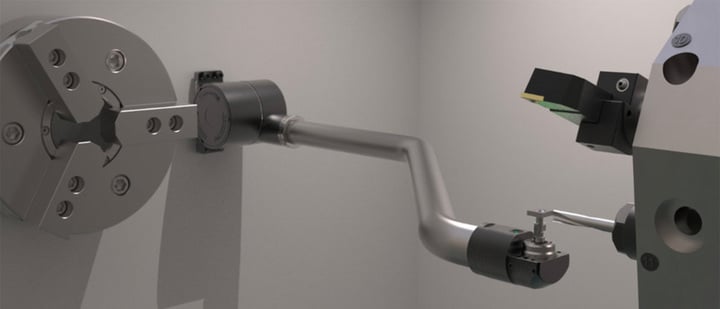
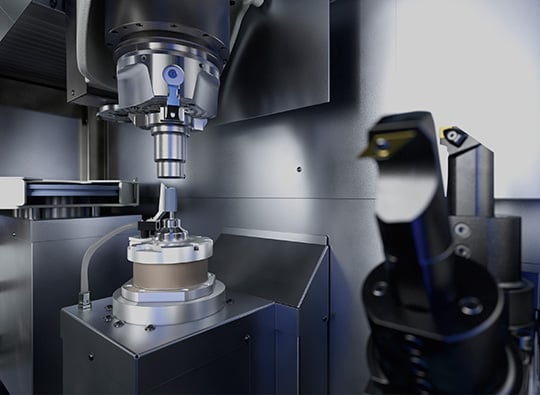
The company’s industrial strategy is based on a three-phase approach: machining, assembly and bench testing. It incorporates 4-axis, 5-axis and palletised 5-axis milling techniques, turning, combined turning and milling, bar turning, and wire and die-sinking EDM on diameters ranging from 0.02 to 0.25. The combination of these different techniques enables customers to submit their design and walk away with a finished, assembled part, whether it be a prototype, a single unit or a production run of several thousand units per month.
As soon as the drawings are received, the Methods and Industrialisation Department team reviews the request and suggests any necessary adjustments. When dealing with complex components, she liaises with design offices, buyers and project managers to ensure production runs smoothly in terms of both time and quality, covering machining, assembly and test benches. Ensuring competitiveness for each project is a priority.
Machining
Thanks to its expertise in processes such as turning, milling, bar turning, grinding, finishing and deburring, Cenats specialises in the manufacture of complex parts with tolerances of up to ±5 µm. These challenges relating to precision and the optimisation of part production times require careful consideration beforehand of the various machining strategies to be employed, particularly with a view to minimising the number of machining operations.

Precision assembly
The assembly process involves several operations, such as bonding, orbital welding, crimping, screwing and sealing. Some of the assemblies and sub-assemblies that Cenats assembles can comprise up to 60 components. This is particularly the case with landing gear components for the aerospace industry, pneumatic tools for clamping collars in the automotive sector, and sensors on probes for the energy sector. The assembly workshop assembles, tests and inspects every part. Any reworking on CNC or conventional machines is carried out as required. Each part is then identified by laser marking or micro-percussion.
Bench testing
The parts manufactured by the company or supplied by its customers are tested on a range of mechanical, hydraulic, pneumatic and kerosene injection test benches, depending on their specific characteristics. These devices are used to check the tightness, flow rate, pressure and strength of sub-assemblies.

Quality control
Cenats manufactures components designed for use in equipment requiring a high level of reliability. To this end, the company has, over time, expanded its testing capabilities to assess the geometric and dimensional tolerances, as well as the surface condition, of parts at every stage of manufacture and assembly. The ‘Quality Control/Metrology’ department comprises five people, who have access to conventional metrology equipment to carry out visual inspections of surface finish, as well as dimensional checks using touch probes or optical systems. The inspection methods are tailored to the tolerance range. All parts produced within a tolerance of ±5 µm are therefore inspected.
The company is EN 9100-certified and ensures compliance with documented quality control procedures. All production areas (EDM, bar turning, etc.) are also equipped with dedicated inspection equipment such as measuring columns, gauge blocks and inspection gauges.

Some examples of markets and products
Cenats manufactures high-precision mechanical components for the aerospace sector, including landing gear, engine injectors and hydraulic systems, which meet the requirements of the leading players in the civil and military aviation industries.
In the defence sector, the company manufactures machined parts with complex geometries for critical defence systems. Its expertise in orbital welding, assembly and multi-axis machining ensures optimal performance even under high mechanical and thermal stress.
Cenats is also active in the medical sector, manufacturing precision components for imaging equipment and surgical devices using materials such as stainless steel and titanium.
The manufacture of components for the oil and energy industries is also one of the company’s areas of expertise. In this sector, it ensures strict traceability, certified materials, functional bench testing (strength, pressure, leak testing), and strict adherence to tolerances in high-security areas.
In the luxury sector, Cenats manufactures high-precision mechanical components, particularly for high-end watchmaking, premium connectors and exceptional mechanisms. Manual processes such as lubrication, crimping and final cleaning ensure impeccable quality and a finish that meets the highest aesthetic standards.